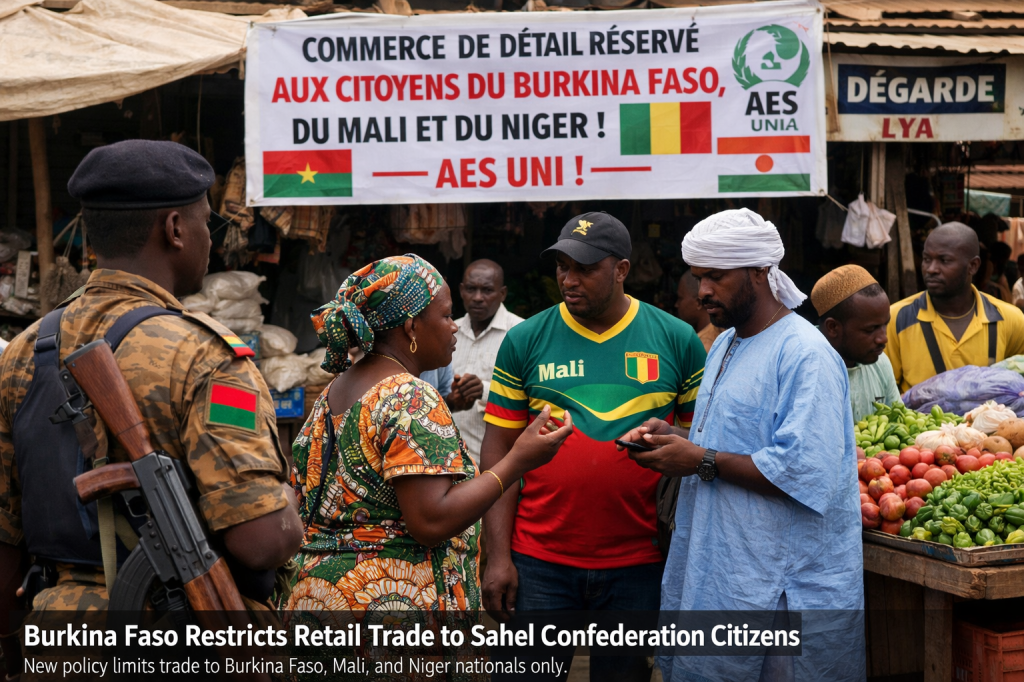
The Burkinabe government has introduced a protective economic measure aimed at prioritizing local and regional traders. Key features include:
- Restricted Retail Trade
- Only Burkina Faso nationals and citizens of the Confederation of Sahel States (AES)—currently including Mali and Niger—can operate retail trade in the domestic market.
- Nationals of other African countries may participate only if they have reciprocal trade agreements with Burkina Faso.
- Ban on “Farm Gate” Purchases by Foreigners
- Foreign nationals are prohibited from buying directly from agricultural, forestry, and livestock producers.
- Objective: prevent predatory pricing and ensure the value of raw materials stays within the country.
- Focus on Local Producers and Small Traders
- Rural producers benefit from higher margins and better bargaining power.
- Small-scale Burkinabe traders gain protection from more organized, well-funded foreign competitors.
- Economic Integration and Regional Focus
- Encourages integration within the Economic and Social Alliance (ESA) of Burkina Faso, Mali, and Niger.
- Aims to strengthen national food sovereignty and job protection.
Intended Objectives
- Protect local livelihoods: By restricting foreign competition, domestic producers can capture more economic value.
- Strengthen regional trade ties: Prioritizing AES members consolidates economic integration in West Africa.
- Promote fair competition: Reduces advantages that foreign distributors have due to capital and logistics.
- Enhance national food security: Controlling farm-gate sales helps regulate domestic food supply chains.
Potential Implications
Positive
- Boosts income for local farmers and small traders.
- Encourages domestic investment and local entrepreneurship.
- Reduces exploitation by foreign buyers in primary sectors.
Challenges
- International retailers may reduce investment in Burkina Faso.
- Risk of price inflation if supply chains are disrupted.
- Enforcement logistics may be complex, especially in border areas.
- Reciprocal agreements need careful negotiation to avoid diplomatic tensions.
Next Steps
- The government has not yet provided an enforcement timeline.
- Stakeholders—including traders, farmers, and foreign investors—will need guidance on compliance rules.
- Regional trade blocs may need to adjust policies to align with Burkina Faso’s new protective measures.
In short, Burkina Faso is reasserting domestic control over retail and agricultural markets, prioritizing national and regional actors, while aiming to safeguard rural incomes and food sovereignty. This is a strongly protectionist policy that could reshape trade dynamics in the Sahel region.
 Africa Must Change | African Youth, Politics & Social Change
Leave a comment